
Attention is
a faculty,
not a mood.
Faculties can be trained. Here's the science underneath — and a small demonstration that lets you feel your own attention at work.
Your attention can darken a circle.
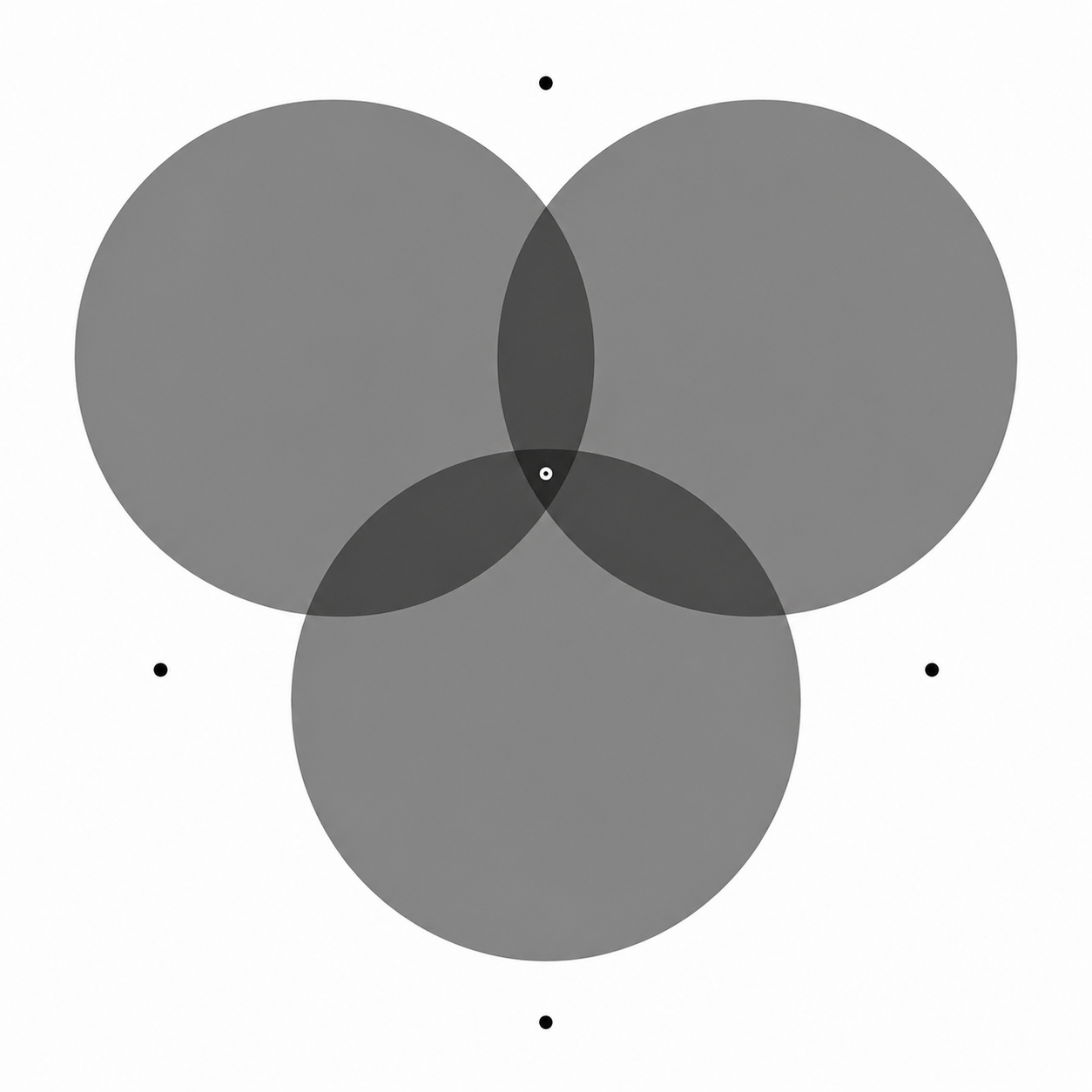
Three overlapping grey circles. Every one is the identical shade.
A small experiment in perception.
The circles overlap like panes of smoked glass. Nothing here is animated. Whatever you are about to notice happens entirely inside you.
Notice anything? The circle under your attention may have begun to deepen, sinking a shade darker than the others. The screen never changed. That shift happened in you.
See it faintly, or not at all? That is expected. And it is the point. The effect varies between people and from moment to moment. That variation is attention itself, fluctuating.
Nothing on the screen changed. A fixed grey held one fixed value the entire time. The darkening was real — but it was made by you.
For three centuries, attention was imagined as a spotlight: a beam that simply reveals whatever it lands on, leaving the world untouched. The illusion above breaks that picture. Attention reached into your perception and altered it. It did not find a darker disk; it produced one.
That raises the question this whole page exists to answer. If attention is an active faculty — something you do rather than something that happens to you — then the next question is the obvious one. Can it be trained? Fifty years of cognitive neuroscience says yes.
Attention is not one thing. It is a system — and systems can be trained.
William James — the philosopher who founded modern psychology — first defined attention in 1890. It took another century for neuroscience to map it. The work of Michael Posner and colleagues established that what we loosely call "attention" is in fact at least three distinct, separable networks in the brain. Each is measurable, each independent, and each responsive to practice.
Alerting
Reaching and holding a state of readiness: the difference between drowsy and primed. The baseline tone the other networks run on.
Orienting
Selecting where attention goes, moving the focus toward what matters and away from what doesn’t, in space and in thought.
Executive
Resolving conflict, staying with what you've chosen while competing pulls fight for the same focus. The network closest to "willpower."
This matters for one reason. A capacity that is structured is a capacity that can be exercised: deliberately, in specific ways, with progress that can be measured. That is the premise underneath every part of Glide.
These three networks are the machinery. What you feel when they run is simpler, and it comes in three kinds.
Directed, and yet effortless.
You have felt three kinds of attention. The kind that is pulled, a noise, your name called out, gone before you chose it. The kind you push, focus held by force, which works for a while and then slips. And a third.
William James saw it in that same 1890 work: attention that is directed like the kind you push, yet effortless like the kind that is pulled. Aimed where you want it, without the strain of holding it there. He called the training of this faculty "the education par excellence."
This is the state athletes call the zone. Its precise name is fluid attention. Directed and effortless at once, it is the mark of trained attention rather than forced attention, and it is the state Glide trains toward.
James named the third kind, and left one question open: how do you train it? The rest of this page is the answer.
You train it by bringing it back.
Part of the answer, James gave himself. The training of this faculty, he wrote, is "the faculty of voluntarily bringing back a wandering attention, over and over again." Not holding still by force. Noticing the drift, and coming back. The coming-back is the rep.
Every attention practice runs on this loop: rest attention on something, notice when it leaves, bring it back. But the noticing and the bringing-back are two different skills, and you can have one without the other — you can know your mind has wandered and still not be able to pull it back.
Awareness is the noticing. Control is the return. Mindfulness trains the noticing, through stillness, observing the breath and coming back when the mind wanders. Glide trains the whole loop, the noticing and the return, through motion. The return doesn't need stillness at all. In cognitive research, structured attention exercises train the same move — off the distraction, back to the task — in people who have never meditated.
Glide gives attention an external anchor that moves. Your hand turns the wheel, continuously and in time. Glide adapts in response, in touch, rhythm, sound and vision. Your attention is what couples the two. Hold the coupling steady and the system reads it as sync; lose it, and it invites you back. Each return is a rep, and because the coupling is physical and ongoing, you can see it and practise it, session by session: the directed ease of the third kind, turned into reps.
Glide trains two things at once: staying with what you've chosen, and noticing when you've drifted. The second is harder, and it matters more. The drift is expected. It is never penalised; it is the cue to return.
Motor synchronisation is a well-established concept in cognitive science and motor-learning research. What Glide claims as its own is the operational design that brings this to life, held in separate patent applications and outside the scope of this page.
You’ve felt what attention can do. Now train it.
Glide opens to the public soon. Join the waitlist to be there on the first day.